
Air dry clay drying time runs from twenty-four to seventy-two hours for pieces rolled six millimetres thick, and far longer for anything solid. Thickness decides it rather than the clock. Roll evenly, dry on a wire rack so air reaches both faces, turn twice a day, and weigh a test piece until it stops losing weight.
Nothing about a first air dry clay project is as confusing as the waiting. The piece looks finished within hours and stays cold and heavy in the hand for days afterwards.
Thickness is what decides it, not the clock. A 6mm pendant is dry overnight; a solid 30mm figure can take a fortnight, and no amount of warm air moves water out of the middle any faster than it can travel there.
The air dry clay hub has the projects. This is the timing underneath all of them.
Materials
- A block of air dry clay
- A little water
- Fine sandpaper
Tools
- Wooden rolling pin
- Two guide strips about 6mm thick
- Round metal cutter about 7cm across
- Wire cooling rack
- Small kitchen scale
Ten minutes of setting up, then two or three days of leaving it alone.
What is the real air dry clay drying time?
Twenty-four to seventy-two hours for work rolled 6mm thick, in an ordinary room, turned twice a day. Every extra few millimetres roughly doubles it, and a piece is only genuinely dry once it has stopped losing weight.
1Set out what you need
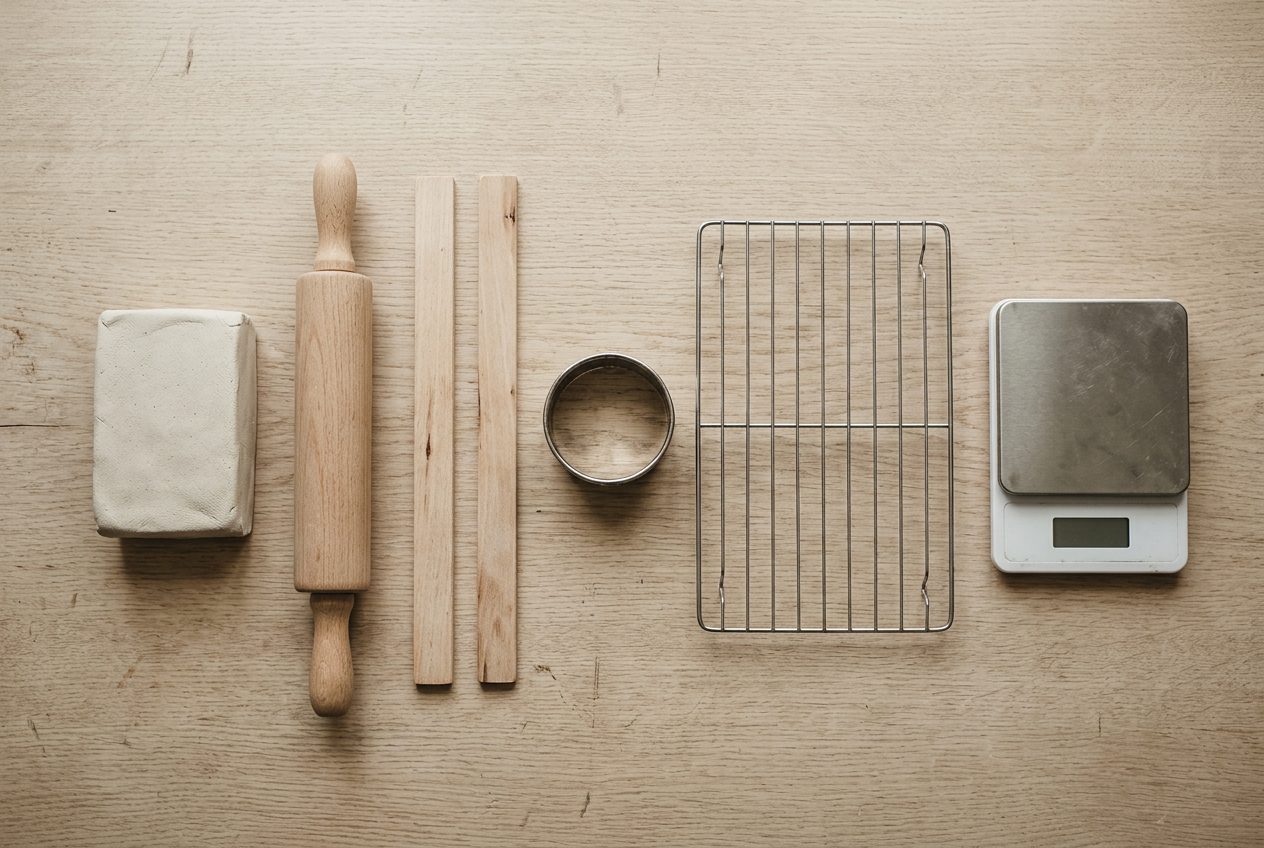
The scale is the part people leave out, and it is the only tool here that answers the question properly. Everything else is a guess.
Guide strips can be anything of an even thickness: two rulers, two lolly sticks, two lengths of moulding from a DIY shop.
A wire cooling rack from the kitchen is ideal. Air has to reach both faces or half the piece never dries.
2Roll every piece to one thickness
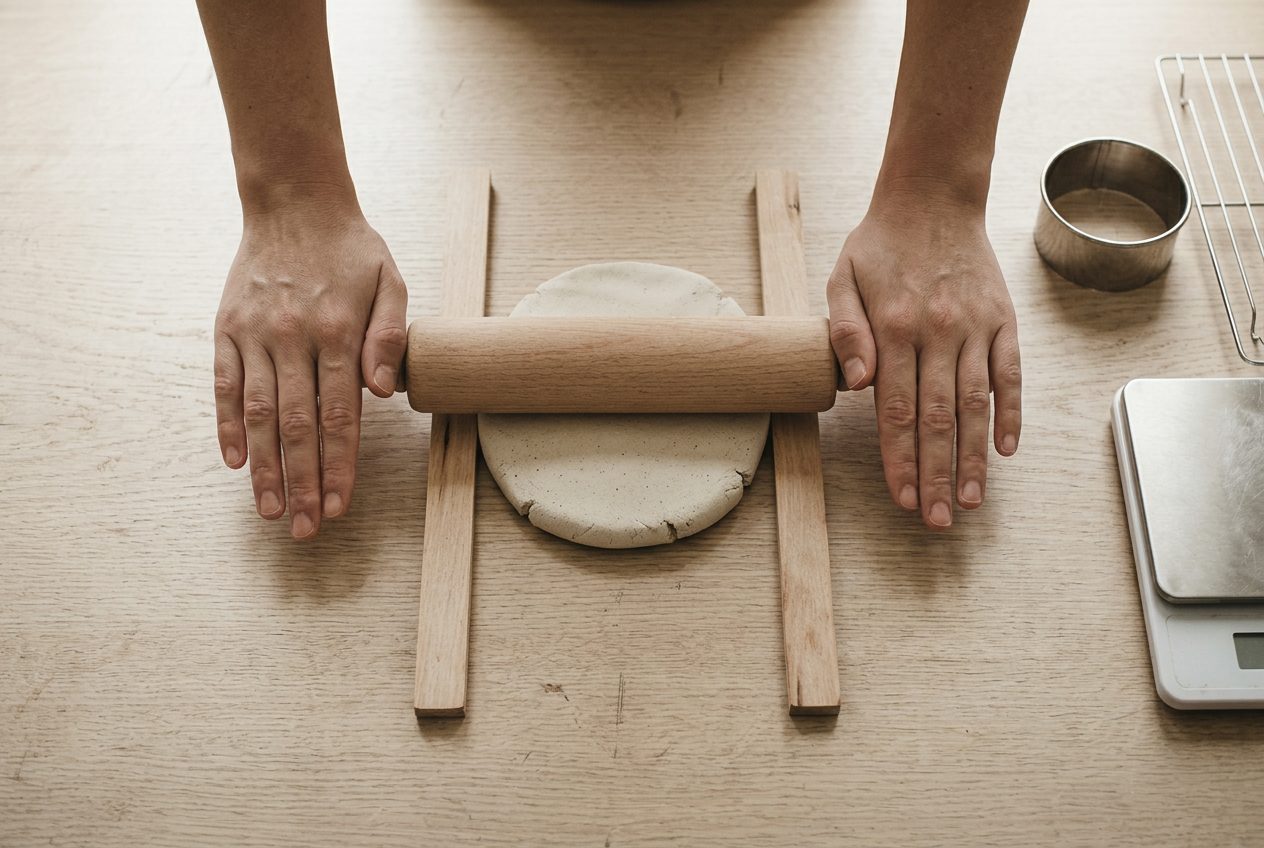
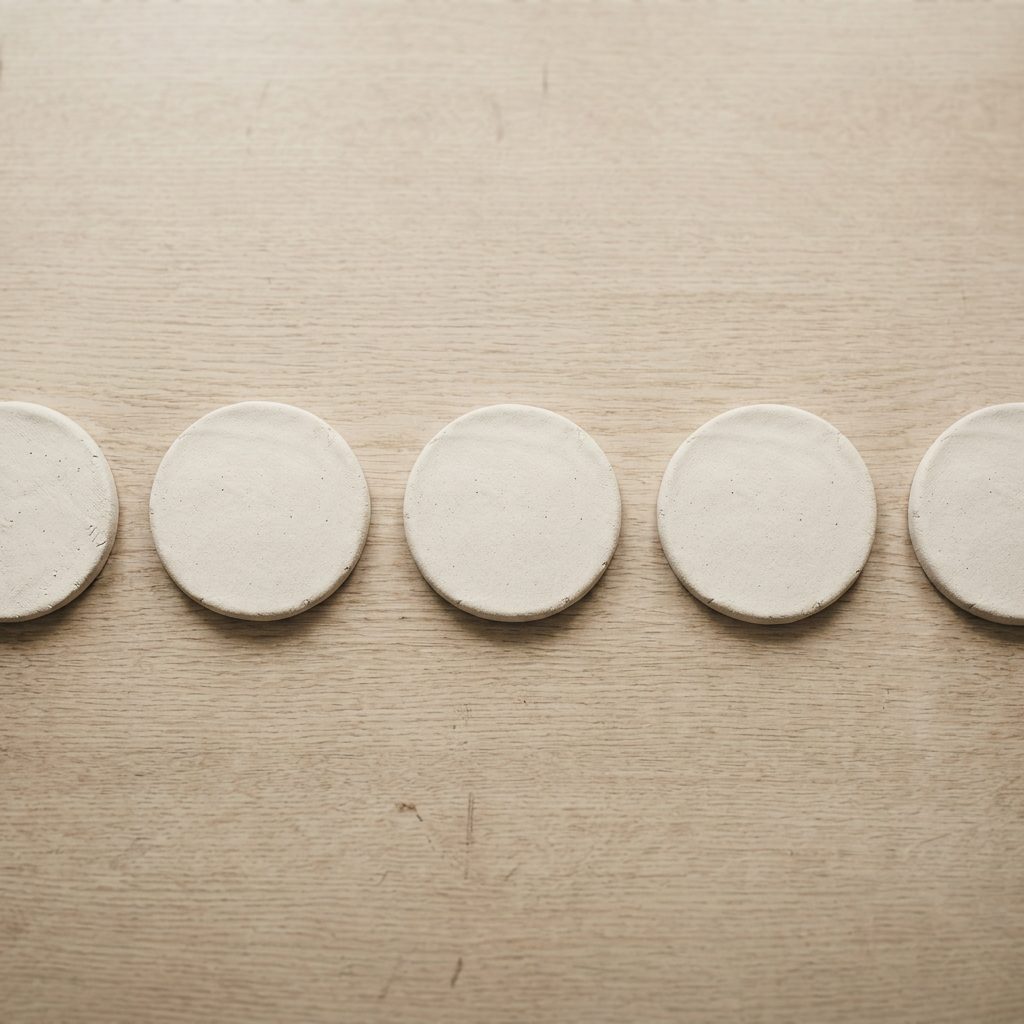
Roll between the strips until the pin rides on both of them. That is the only reliable way to get one thickness across a whole sheet.
Even thickness is a drying instruction as much as a neatness one. A sheet that is 4mm at one end and 9mm at the other dries at two speeds and splits along the join.
Thin work dries fast and warps easily. Thick work dries slowly and cracks. Six millimetres is the compromise nearly every flat project lands on.
3Dry on a rack, not on the table
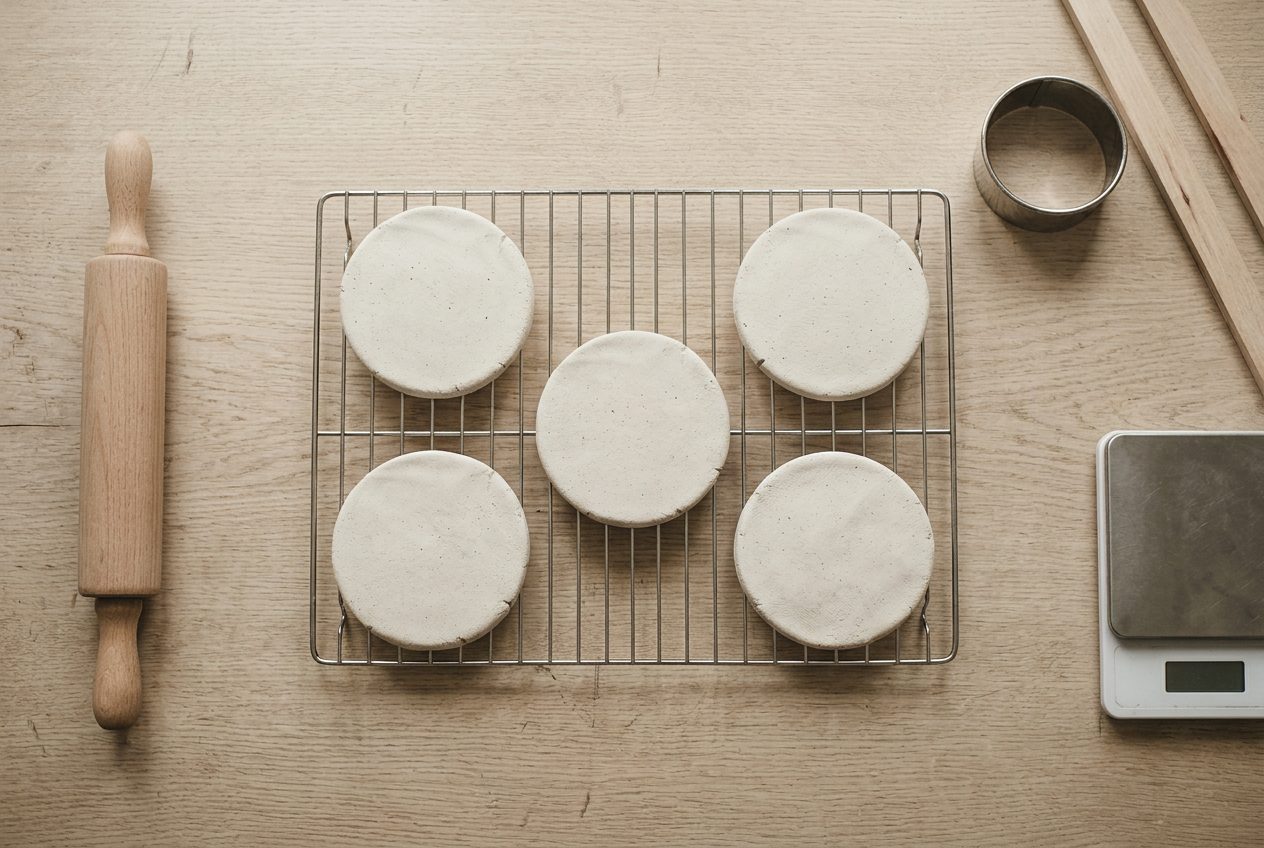
The underside is the problem. On a flat table it sits in its own damp air and stays soft long after the top has gone hard.
Space the pieces out so nothing touches. Two discs pressed together dry into one damp patch between them.
Somewhere cool with moving air beats somewhere warm and still. An airing cupboard is worse than a shaded windowsill with the window ajar.
4Turn each piece twice a day
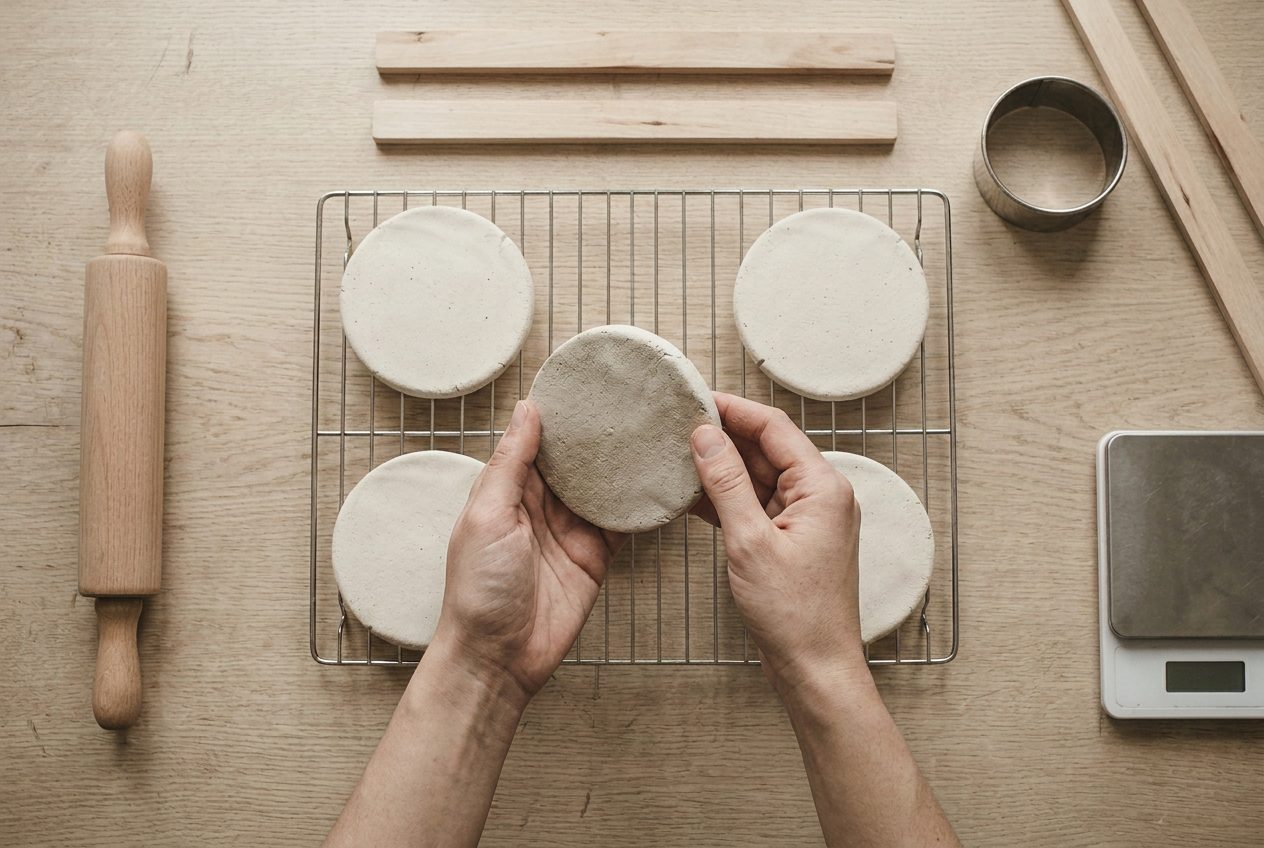
Morning and evening is enough. The point is that neither face gets a long head start on the other.
Curling comes from exactly this. The dry face shrinks, the damp face does not, and the rim lifts.
You can see it working: the underside comes up visibly darker for the first day, then the two faces start to match.
5Weigh one piece every morning
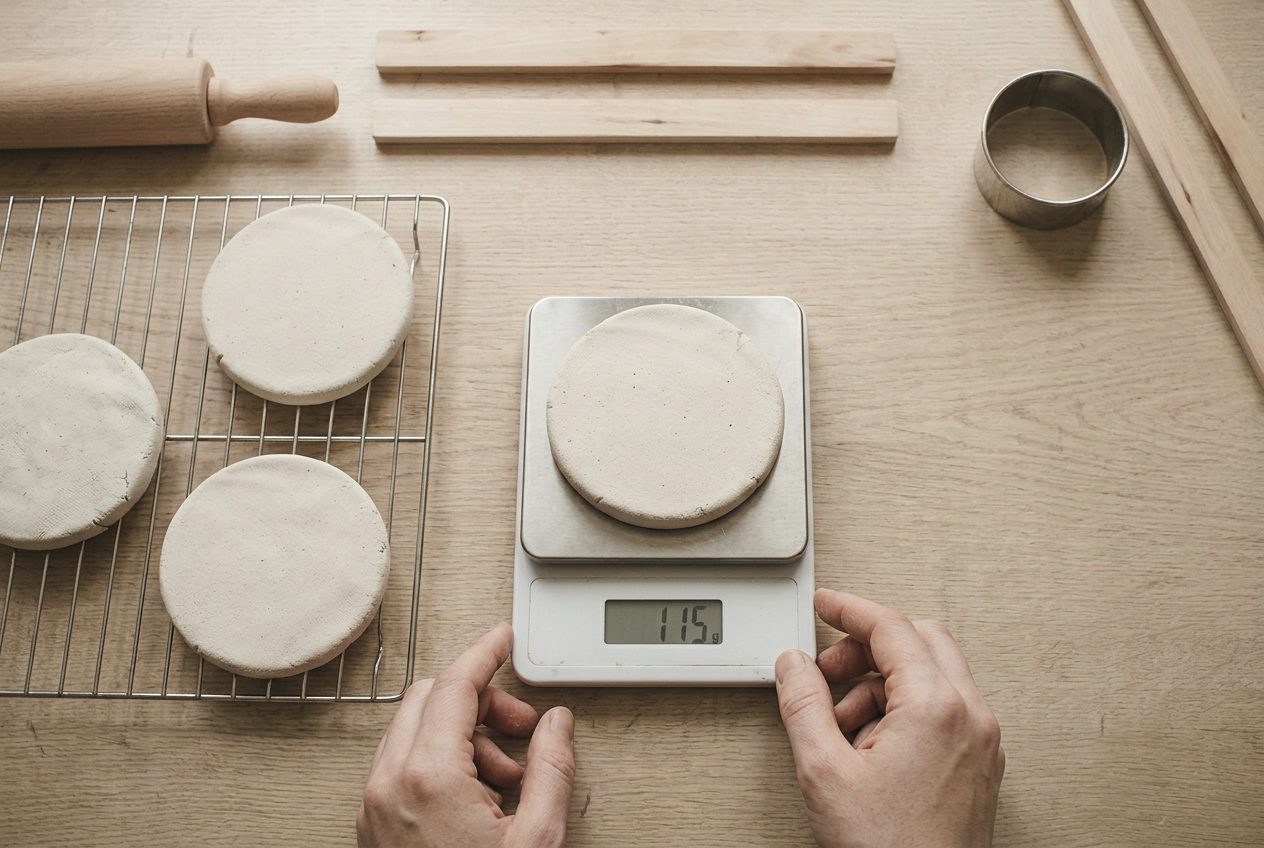
Pick one piece, weigh it, write the number on a scrap of paper. Do it at the same time each day.
A wet disc loses several grams a day at first, then less, then nothing. Drying has finished when two consecutive mornings give the same reading.
This sounds fussy for a craft project, and it takes ten seconds. It is also the only method here that does not depend on how a piece happens to feel that morning.
6Check it is dry right through
Hold a piece against the back of your hand. Cool means water is still evaporating out of it, and cool is the single most reliable tell there is.
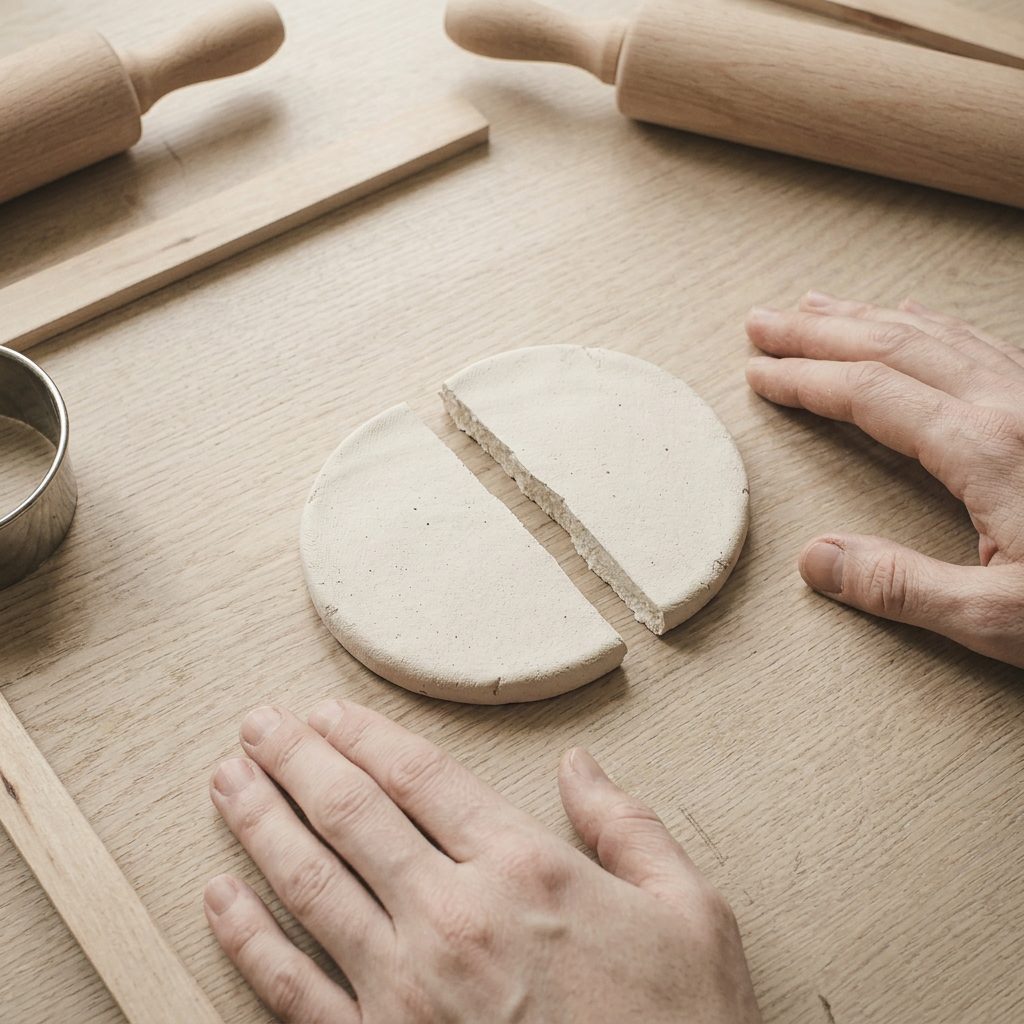
If you have a spare, snap it. A darker band through the middle of the break means the whole batch needs another two days.
Only then sand, paint or seal it. The finishing hub covers what goes on top once the clay itself is sound.
If it goes wrong
| Problem | Likely cause | How to fix it |
|---|---|---|
| The piece is hard on top and still soft underneath | It dried on a flat surface, so no air ever reached the bottom face | Move it to a wire rack and turn it twice a day. Expect to add a day or two to the total for every day it sat flat. |
| The edges lifted and the middle stayed flat | One face dried and shrank ahead of the other, which pulls the rim upwards | Turn every piece morning and evening. A curled piece can be weighted flat under a board while it is still slightly damp. |
| Cracks opened across the surface on day one | It was dried too fast, usually on a radiator or in direct sun | Dry at room temperature, away from heat. Fill the cracks with a paste of the same clay and water, then dry slowly. |
| It felt dry, then went soft again after sealing | Water still in the middle had nowhere to go once the surface was sealed | Never seal until the weight has been steady for two days. A sealed damp piece will eventually soften and crumble. |
Can you speed up air dry clay drying?
A little, and only in one direction: more air, not more heat.
A fan on its lowest setting across the room, or an open window, moves the damp air away from the surface and genuinely shortens the wait. It is the least harmful accelerator there is.
Heat does the opposite of what people expect. A radiator or a low oven dries the outside into a hard shell in an hour while the middle is still fully wet, and the shell then cracks as the inside shrinks underneath it.
Hollowing helps more than anything else. A pinch pot with 8mm walls dries in three days; the same lump of clay left solid takes two weeks and usually cracks doing it.
Thin, hollow and airy beats warm every time. The troubleshooting hub has the cracks that come from ignoring this.
Why is air dry clay still soft in the middle?
Because water leaves from the surface, and it can only leave as fast as it can travel there from the centre.
That travel is slow, and it slows further as the outer few millimetres firm up. A 25mm thick piece is not four times slower than a 6mm one; it is closer to ten times slower.
Sealing a piece that is soft in the middle is the version of this that ruins finished work. The water has nowhere to go, and weeks later the piece softens, stains through the paint or crumbles at a corner.
A cold room with damp air stalls it too. Below about 15C with the windows shut, expect to double every figure on this page.
If in doubt, wait another day. Nothing is lost by leaving air dry clay alone, and the techniques hub assumes throughout that pieces are properly dry before anything else happens to them.
Frequently asked questions
How long does air dry clay take to dry?
Twenty-four to seventy-two hours at 6mm thick in a normal room. Solid pieces over 20mm can take one to two weeks.
Can you speed up air dry clay drying?
Only a little, and only safely. Moving air helps; heat does not, because it dries the surface into a shell while the middle stays wet.
How do you know when air dry clay is fully dry?
It stops losing weight and it is no longer cool against the back of the hand. Cool means water is still evaporating out of it.
Why is my air dry clay still soft after three days?
It is thicker than 6mm, sitting flat on a table, or the room is cold and damp. All three double the time on their own.